Cybersecurity and Managed IT Services for Oklahoma Businesses

Reduce your cyber risk in 90 days with proactive protection, always-on monitoring, and real-world defense strategies

Get a Cyber Risk Review

How Do We Reduce Cyber Risk?


Cybersecurity

Proactive protection that stops cyber threats before they impact your business.

More About Cybersecurity

Cyber Liability

Financial protection that helps your business recover quickly after a cyber incident.

More About Cyber Liability

Managed IT Services๏ปฟ

Reliable IT management that keeps your systems secure, stable, and supported.

More About Managed IT Services

Your Path to Protection


1. Risk & Liability Assessment


We start by understanding your business, your data, and your exposure. This includes a high level security review and a real conversation about liability, compliance, and what a breach would actually mean for you.

2. Vulnerability Discovery


Next, we identify the gaps. From email and endpoints to network and user behavior, we uncover where attackers would strike first and how they would get in.๏ปฟ

3. Security Strategy & Roadmap

๏ปฟ

No cookie cutter solutions. We build a security plan tailored to your risk level, budget, and business goals, prioritizing what protects you the fastest and reduces liability the most.

4. Protection Deployment


We implement layered defenses across email, endpoints, networks, identities, and users. This is where real protection goes live and weak points get locked down.

5. Ongoing Monitoring & Hardening


Security is never set it and forget it. We continuously monitor, alert, train users, and strengthen defenses as threats evolve, keeping you protected long term.

Globally Recognized Partners


quotesArtboard 1 copy 2

I lose sleep so you don’t have to.


While you are running your business, serving customers, and trying to grow, cyber threats do not stop. Hackers do not care how small your company is or how busy your day gets. That is where I come in.


My job is simple. Worry about cybersecurity so you can focus on everything else. I obsess over threats, vulnerabilities, and weak points before attackers can exploit them. I believe businesses deserve real protection, not buzzwords, and security that actually works in the real world.


If you rely on email, data, or technology to run your business, you are already a target. You do not have to face that risk alone.


Let’s find out where you stand and what needs to be fixed.

Braden A. Lampe

CEO, ABT Solutions.

Latest from Our Blog

To stay ahead of cyber threats, our team shares tips and updates on cybersecurity and IT topics. Check out our latest insights to enhance your cybersecurity measures.

Visit Our Cybersecurity Blog

Blog Posts

By b328cabadd620e9eeb96502345549129_cc_2214 February 24, 2026
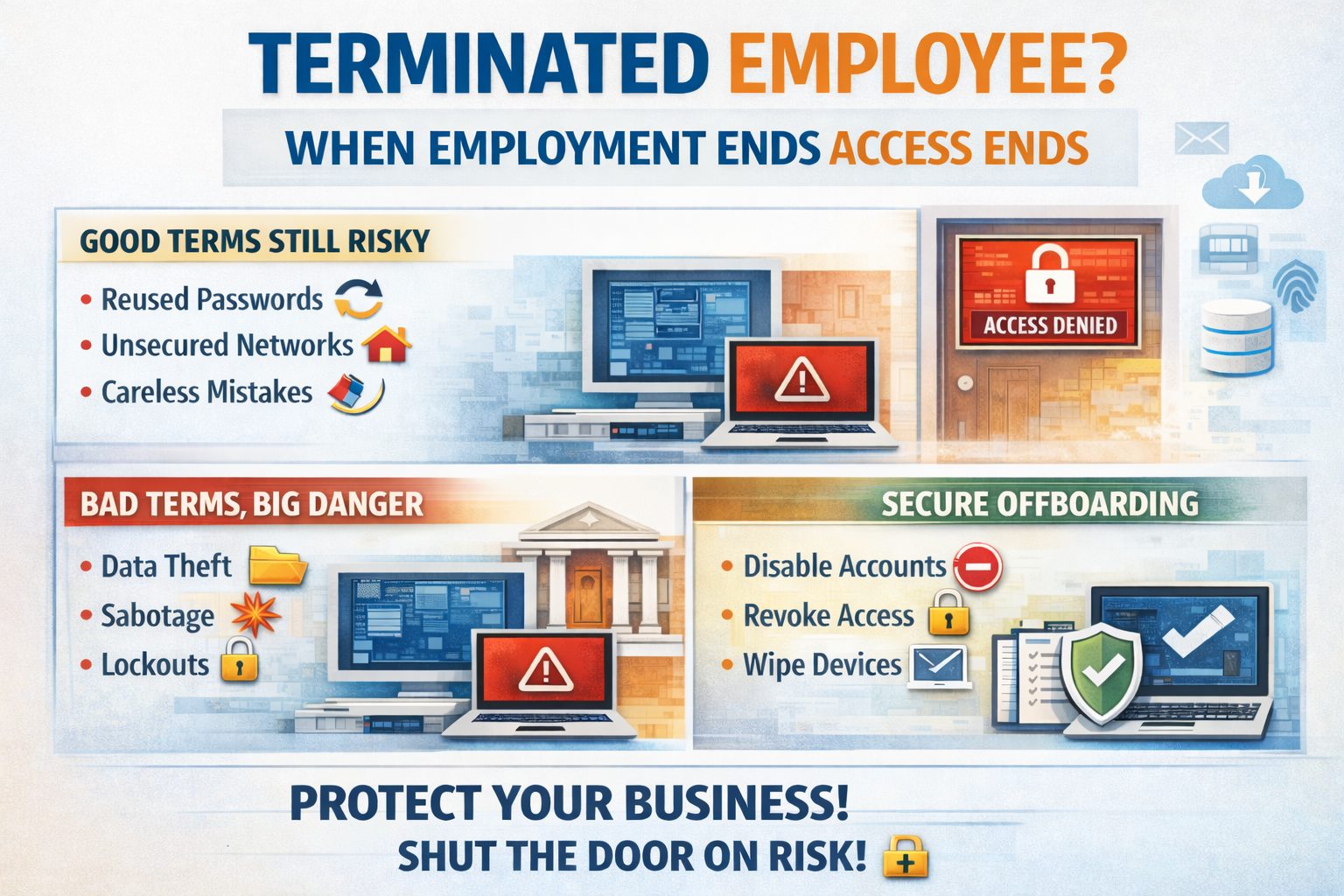
When an employee leaves your company, whether it is a handshake and well wishes ๐Ÿค or a slammed door on the way out ๐Ÿšช, one rule should always apply . Cut. Off. Access. ๐Ÿ” Immediately. โฑ๏ธ Too many businesses treat offboarding like an afterthought. They collect the keys, maybe grab the laptop, and call it good. Meanwhile, that former employee still has email access, VPN credentials, cloud logins, saved passwords on personal devices, and maybe even administrative rights. That is not just sloppy. That is dangerous. โš ๏ธ Good terms do not equal good security Let’s start with the comfortable lie. “He left on good terms.” Great. That is good for morale. It has absolutely nothing to do with risk. Even the most professional, kind, and well meaning former employee is no longer bound by the same sense of responsibility once they are outside your walls. Priorities change. Emotions change. Financial pressure changes people. And sometimes it is not about intent at all. They may reuse passwords. They may store credentials in a personal password manager. They may log in from an unsecured home network. They may click on something malicious using an account that still belongs to you. Now you have exposure and they are not even on payroll. That is a problem. ๐Ÿšจ Messy breakups are obvious risks If the separation was tense, emotional, or disciplinary, the risk increases exponentially. A disgruntled former employee with active access can: • Download sensitive data ๐Ÿ“‚ • Delete shared files ๐Ÿ—‘๏ธ • Forward confidential emails ๐Ÿ“ค • Lock accounts ๐Ÿ”’ • Alter financial information ๐Ÿ’ฐ • Sabotage systems ๐Ÿงจ And here is the hard truth. It does not take a sophisticated hacker to cause real damage. It takes one valid login. Access is power. Remove the access. ๐Ÿ›‘ The part most businesses forget Here is what keeps attorneys busy. โš–๏ธ If a former employee’s credentials are used in a breach, whether by them or by someone else who got access to those credentials, you are in trouble. Why? Because you failed to follow basic security hygiene. If their account was still active and used in a data breach, the argument against you becomes simple: You knew they were no longer employed. You knew they had access. You failed to disable it. The breach happened because of that access. That is negligence territory. And in court, that is not a fun place to stand. You will lose. โŒ It is not personal. It is policy. The best way to handle offboarding is to remove emotion from the process. Every departure should trigger a documented checklist: Disable Microsoft 365 account ๐Ÿง‘‍๐Ÿ’ป Revoke VPN access ๐ŸŒ Remove MFA tokens ๐Ÿ“ฒ Terminate remote management access ๐Ÿ–ฅ๏ธ Disable line of business application logins ๐Ÿ“Š Collect and wipe company devices ๐Ÿ’ป Rotate shared passwords ๐Ÿ”„ Remove access from third party vendors and portals ๐Ÿข No exceptions. No delays. No waiting until the end of the week. The moment employment ends, access ends. โ›” Compliance and insurance are watching Cyber insurance carriers expect strict offboarding procedures. Many policies now specifically require prompt revocation of user access upon termination. Regulators expect it. ๐Ÿ›๏ธ Auditors expect it. ๐Ÿ“‹ Insurance expects it. ๐Ÿ›ก๏ธ If you cannot prove you removed access immediately, you are exposed financially and legally. This is about protecting your business You work too hard to build your company to let a forgotten login tear it down. It is not about distrust. It is not about assuming the worst in people. It is about understanding reality. Credentials left active are open doors. ๐Ÿšช Open doors invite problems. Problems turn into breaches. ๐Ÿ’ฅ Breaches turn into lawsuits. โš–๏ธ And lawsuits are expensive. ๐Ÿ’ธ Shut the door. ๐Ÿ”’ If you are not confident that your offboarding process immediately and completely removes access across every system, it is time to fix that. Because the cost of doing it right is tiny compared to the cost of explaining to a judge why you did not. Learn more about cyber liability insurance here.
By b328cabadd620e9eeb96502345549129_cc_2214 February 24, 2026
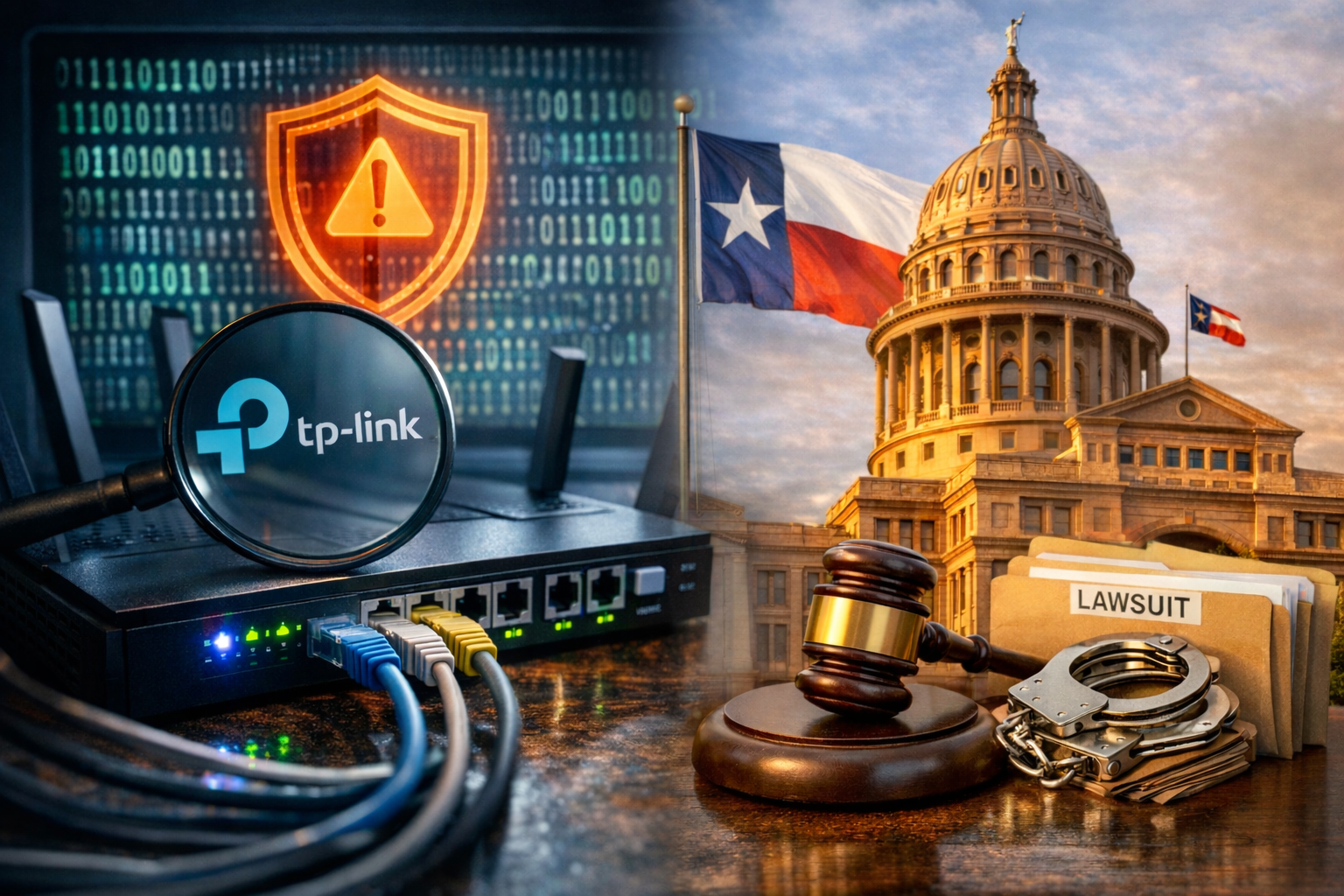
๐Ÿšจ TP Link Is in Legal Trouble and Your Business Should Pay Attention ๐Ÿšจ Texas has officially taken action against TP Link. โš–๏ธ The lawsuit centers around serious cybersecurity concerns tied to networking equipment used in homes and businesses across the country. When a state like Texas steps in, it is not random. It signals risk. It signals scrutiny. And it signals that more may follow. If one state attorney general moves, others watch closely. ๐Ÿ‘€ If vulnerabilities appear systemic, regulatory pressure spreads fast. This is how it starts. ๐Ÿ”ฅ Why This Matters to Your Business Your router is not just a box with blinking lights. ๐Ÿ’ก It is the gateway to your entire company. If your network equipment has unresolved vulnerabilities or questionable security practices behind it, everything connected to it is exposed. • Customer data ๐Ÿ“ • Financial systems ๐Ÿ’ณ • Email accounts ๐Ÿ“ง • Cloud platforms โ˜๏ธ • Internal documents ๐Ÿ“‚ Cheap networking gear can become the most expensive mistake you ever make. ๐Ÿ’ธ Attackers do not look for the biggest company. They look for the easiest door. ๐Ÿšช โš ๏ธ If You Have TP Link Equipment This is not a wait and see moment. If you have TP Link routers, switches, or access points in your business, you need to evaluate that immediately. โœ”๏ธ Inventory every networking device โœ”๏ธ Check firmware versions โœ”๏ธ Confirm devices are still supported โœ”๏ธ Review known vulnerabilities โœ”๏ธ Create a replacement plan if necessary If you do not know how to answer those questions, that is a problem. ๐Ÿšฉ ๐Ÿง  Your IT Provider Should Have Seen This Coming. A proactive cybersecurity partner monitors: • Vendor risk • Firmware update history • Security advisories • National security warnings • Legal and regulatory movement They do not wait for headlines. ๐Ÿ“ฐ They anticipate them. If this is the first you are hearing about risk tied to your networking hardware, you need to ask some serious questions. Cybersecurity is not about reacting. It is about preventing. ๐Ÿ›ก๏ธ ๐Ÿšช If You Had No Idea If you have no clue what brand of router protects your business, that is not a small oversight. That is exposure. Businesses are not too small to be targeted. ๐ŸŽฏ In fact, they are often targeted because they are small. ๐Ÿ’ฅ The Bottom Line Texas made a move. Others may follow. Your network should never be your weakest link. If you want clarity on where you stand, now is the time to find out. Because hackers love confusion. And we love shutting doors before they ever get opened. ๐Ÿ”
By b328cabadd620e9eeb96502345549129_cc_2214 February 4, 2026
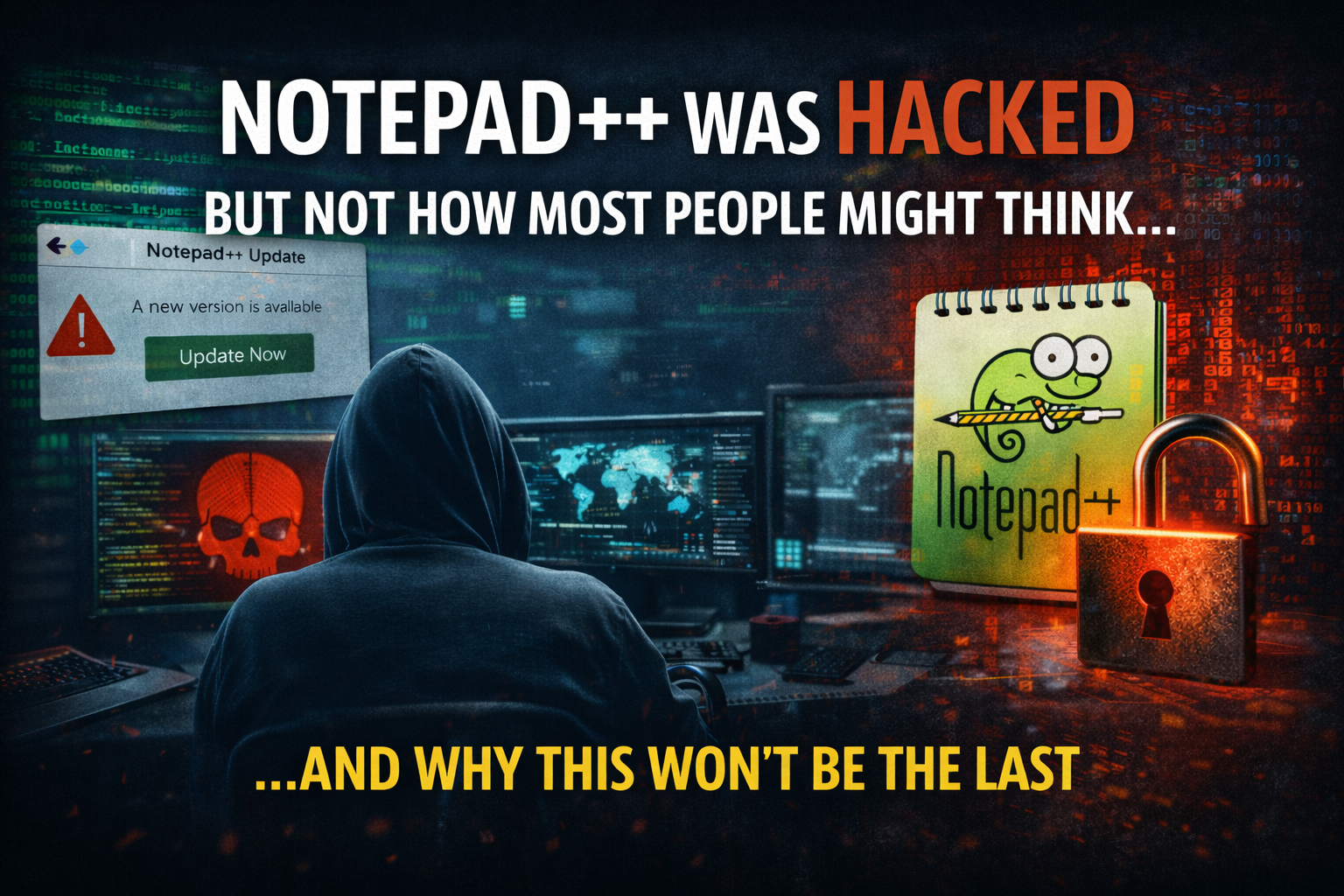
Notepad++ has been around forever. It is lightweight trusted open source and installed on millions of systems worldwide. Developers IT admins engineers and power users rely on it daily without a second thought. That is exactly why it became a perfect target. This was not a vulnerability in the code itself. Notepad++ was not hacked in the traditional sense. Instead attackers went after something far more dangerous. Trust . What Actually Happened Attackers compromised infrastructure involved in distributing Notepad++ updates. For users running older versions of the updater the software could be silently redirected to attacker controlled servers. Those users believed they were downloading a legitimate update from a trusted source. In reality they were handed malware. The payload tied to this incident was linked to a sophisticated threat group known as Lotus Blossom. Researchers identified a custom backdoor called Chrysalis designed for stealth persistence and long term access. This was not smash and grab malware. It was engineered to live quietly inside environments. Once installed Chrysalis allowed attackers to maintain remote access exfiltrate data and blend in with normal system activity. No pop ups. No obvious signs. Just quiet control. This is what makes the incident so dangerous. Everything looked normal. Why This Attack Worked Supply chain attacks work because they abuse assumptions we all make. We assume updates are safe We assume trusted software stays trusted We assume open-source equals secure We assume attackers go after big flashy targets Every one of those assumptions is wrong. Attackers did not need to exploit Notepad++ users directly. They did not need phishing emails or malicious links. They simply waited for users to do what they are supposed to do. Update their software. Once attackers control the update path they control the endpoint. Why This Wont Be The Last Notepad++ is not special. It is representative. Every environment relies on dozens or hundreds of third party tools. Updaters agents plugins utilities browser extensions remote tools and open source software are everywhere. Many of them run with elevated permissions. Many of them auto update. Many of them assume trust instead of verifying it. Attackers know this. Supply chain attacks scale better than phishing. They bypass user awareness training. They slip past perimeter defenses. They land inside trusted workflows where security tools are less suspicious. And most organizations do not monitor software integrity closely enough to catch it early. The uncomfortable truth is this. Another trusted tool will be compromised. The only unknowns are which one and who gets hit. What This Means For Businesses If your security strategy assumes that trusted software equals safe software you already have a blind spot. Modern security requires more than antivirus and patching. It requires visibility into behavior not just signatures. It requires monitoring endpoints for abnormal activity even when the software appears legitimate. It requires assuming compromise and being ready to detect it quickly. Because the next attack will not announce itself. It will arrive quietly through something your team already trusts. Final Thought The Notepad++ incident is not about one tool. It is about a shift in how attacks happen. Attackers are not breaking down doors anymore. They are being invited inside. And unless organizations adapt their security posture this absolutely will not be the last time we see a trusted name turn into an attack vector. If you want help understanding where your environment is exposed or what trusted tools could become your weakest link now is the time to look. Not after the next incident makes headlines.